Showing posts with label ships. Show all posts

Friday, October 13, 2017

AMERICA'S FIRST DATE WITH THE U.S. NAVY

This is the date that the USN claims for it's creation. It's a little far from the truth since one of the first things the Continental Congress did at the conclusion of the Revolutionary War was toss what was left of the Navy over the side. Let us turn to Infogalactic for a brief history lesson on the U.S. Navy.
In August 1785, after the Revolutionary War drew to a close, Congress had sold Alliance, the last ship remaining in the Continental Navy due to a lack of funds to maintain the ship or support a navy. From then until 1797, the United States' only armed maritime service was the Revenue Marine, founded in 1790 at the prompting of Secretary of the Treasury Alexander Hamilton. In the same year, 1785, two American merchant ships had been captured by Algiers and then Minister to France Thomas Jefferson began to urge the need for an American naval force to protect their passage through the Mediterranean. Jefferson's recommendations were initially met with indifference. However, Congress in 1786, and the Senate in 1791, discussed various proposals for a naval force, including estimates of costs for building frigates, but none were acted upon. Only in 1793 when Algiers had captured eleven additional merchant ships was a proposal finally taken seriously.
A bill was presented to the House of Representatives on January 20, 1794, providing for the construction of four ships to carry forty-four guns each, and two ships to carry thirty-six guns each — by purchase or otherwise. The bill also provided pay and sustenance for naval officers and sailors and outlined how each ship should be manned in order to operate them. Opposition to the bill was strong and a clause was added that should peace be established with Algiers the construction of the ships was to cease. 
Piracy had not been a problem when the American colonies were a part of the British Empire; the Royal Navy protected American vessels, since they belonged to subjects of the British Crown. After the American Revolutionary War, however, that protection was lost, and many foreign powers found that they could harass American merchant ships with impunity. Indeed, once the French Revolution started, Britain also started interdicting American merchant ships and there was little the fledgling American government could do about it. This was a major philosophical shift for the young Republic, many of whose leaders felt that a Navy would be too expensive to raise and maintain, too imperialistic, and would unnecessarily provoke the European powers. In the end, however, it was felt necessary to protect American interests at sea. 
In March 1796, as construction of the frigates slowly progressed, a peace accord was announced between the United States and Algiers. In accordance with clause nine of the Naval Act of 1794, a clause that specifically directed that construction of the frigates be discontinued if peace was established, construction on all six ships was halted. After some debate and prompting by President Washington, Congress passed an act on 20 April 1796 allowing the construction and funding to continue only on the three ships nearest to completion: United States,[7] Constellation[8] and Constitution. 
By late 1798 however, France began to seize American merchant vessels and the attempt at a diplomatic resolution had resulted in the XYZ Affair, prompting Congress to approve funds for completion of the remaining three frigates: President, Congress and Chesapeake.
Over the next 20 years, the Navy fought the French Navy in the Quasi-War (1798–99), Barbary states in the First and Second Barbary Wars, and the British in the War of 1812. After the War of 1812, the U.S. Navy was at peace until the Mexican–American War in 1846, and served to combat piracy in the Mediterranean and Caribbean seas, as well fighting the slave trade. In 1845, the Naval Academy was founded. In 1861, the American Civil War began and the U.S. Navy fought the small Confederate Navy with both sailing ships and ironclad ships while forming a blockade that shut down the Confederacy's civilian shipping. After the Civil war, most of the its ships were laid up in reserve, and by 1878, the Navy was just 6,000 men. 
The U.S. Coast Guard claims to be the oldest floating nautical service of the United States since they slowly amalgamated the various life-saving and revenue cutters and then the lighthouses and all the rest of the things they do so well on a shoestring budget.

As you can see from reading the above, once we had an actual Navy the temptation to use it proved irresistible and use it we did. The United States Marine Corps may well quibble with the notion that the USCG is the oldest nautical service since there is some quaint notion that passengers can be nautical if they want to be provided they are embarked on some sort of floating contraption. The Marines have been around since 1775.

However, it is good and proper to celebrate even the temporary establishment of a naval service at any point in the past and this calls for a Party! On the other hand, think where we'd be on the Jones Act if our gutless Congress still issued letters of Marque and Reprisal and let privateers sweep the oceans for prizes. They'd have a hasty way with mere pirates and soon that scourge would be driven from the worlds oceans and seven seas leaving plenty of opportunity for riches and advancement in America's Privateer Fleets.

Saturday, October 7, 2017

FLOATING ANFO

It's not really a bomb because the diesel fuel and fertilizer have not been mixed but it still must have creeped out the crew on the ship.

British bulk carrier MV Cheshire burning


It burned for two weeks off the Canary Islands before all the fertilizer was consumed. When it was toast, it looked like:

Toasted Cheshire with what looks like guano running down the sides

Tuesday, September 26, 2017

YOUR ACTUAL CRUISE MISSILE

As I've said, all the messing about with rockets and missiles in North Korea is a scam designed to distract attention from their real nuclear cruise missile program which is fully deployed and ready for instant action come the day.

Cruise missile arriving in New York City
It looks a lot like the topmost middle container on the delivery system shown above. As you can see, the delivery system is capable of multiple independent reinforced deliveries and has global reach. The actual 'missile body' costs roughly $70,000 although nuclear armed countries may get a discount. To quote somebody or other, "size and weight of the warhead is not an issue anymore."

Thursday, August 24, 2017

COMPACFLEET IS A BOOB

He thinks firing the commander of seventh fleet is a good move. What he utterly failed to get/to understand/to comprehend, is that naval forces are trained and certified by second and third fleets and so, the one that needs to be fired is named Nora and so won't be fired.

If I was president? CINCPACFLT would be putting his resume together and searching for a new job.

I'm like all the old coots that say, "well that didn't happen in my day!"

The fleet I served in had money to burn for fuel and fuel coming out our ears. The current navy is starved for fuel. Synthetic training does now replace real experience driving ships. The only time ships get fuel to steam now is when they are posted to 5th or 7th fleet.

Oh, and their officers suck. I mean they really really suck. I remember sitting next to the COS of the MCM squadron in Korea and hearing him tell his little minions to tell the CO's of MCMs that they were not allowed to so much as put a zodiac in the water without his permission. He was a piece of work. He's probably an admiral.

Friday, August 18, 2017

AH, HOUSTON, WE HAVE A LITTLE PROBLEM

The news I read is frequently filled with words of praise for the mystical rail gun the USN is going to arm itself with any minute now. It's a wonderf#uckingment of a weapon. It can reach out and touch somebody really really hard. When it works. People used to marvel at the awesome power of the dreadnought and battlewagon but one of the lesser known history whatchamacallits of WWII is that battleships never fired on other battleships. They were mostly destroyed by Billy Mitchell's little devils long before they could get into battle range of the enemy.  There, fixed it.

And so now, the rail gun is going to change naval warfare because, rail gun. You may remember the Russian navy had one of it's frigates and one of its corvettes fire ship killing missiles from almost a thousand miles away and make kills on their targets. What part of thousands of miles of range are we missing out on when we concentrate our research on a weapon that is only good for shooting things within the horizon? You know, that whole curvature of the earth thingie means that the rail guns speedy bullets won't actually hit anything 13 miles away, right? You got that? Shooting over is also called a miss.

Silly naval strategists. The USN doesn't have those kinds of missiles. It might find them useful in a fight.

Speaking strictly as an old fire control officer who thought putting Harpoon missiles in BOL on a snoop tray radar was a good tactic. They may not make it there but they'll die trying.

Monday, May 2, 2016

HMS ENDEAVOUR

According to the Daily Mail, the former HMS Endeavour was found. This was the ship sailed by Captain Cook when he discovered and explored the east coast of Australia in 1769-71, and it has turned up in Newport, Rhode Island.


She completed a three year voyage of discovery, returned to England and vanished from history, only to be rediscovered herself. The ship and crew made a fascinating journey. I kind of miss those days.
Laugh, Kookaburra, laugh, fixed it now.

Wednesday, March 2, 2016

EAST VS WEST

A long time ago we had six small warships of the Reserve sail in harm's way for month after month, year after year while they were based out of one of the smallest kingdoms in the world. The little ships were manned at something like three to four times their normal manning because they were Reserve ships where fewer do more with less than anyone else.  In other words, ships that had routinely heretofore, gotten underway for voyages of thousands of miles with just 30 crew onboard, were now fighting the good fight with crews of 100 or more. There literally wasn't room to house them all and many slept on mattresses scattered about on the deck and others were jammed into bunks 3 tall that had been jammed alike into spaces already crowded with men and the equipment used to fight the ship.

There were three, nearly identical ships from the Pacific fleet and three nearly identical ships from the Atlantic fleet. They were yet, profoundly different in almost every respect. I, for one, find it unlikely that any of my counterparts would tear apart all four main engines while anchored next to a minefield and gap the tolerances between the engine drive shaft and the reduction gear shafting, toss their hands in the air, moan about unacceptable tolerances that were thousands of an inch off and refuse to get underway until the situation was resolved and the engines realigned.

Every sailor knows that his ship is better than the other guys' unless he has decided to adopt the next best strategy and declare his the worst ship that ever was suffered to float upon the ocean. There's no detectable difference between the two types when they pitch in to fight the ship. Some guys just like drama and to bitch and moan about things because, superstition. You don't want the God's to find out how happy you are because sure as NAVSEA is a pack of shiftless lazy no-goodnicks making money out of your sweat, they'll take it away from you and send you someplace worse. Much worse.

We used to do this thing with the newly reported drafts of men that reported aboard the 3 ships from the professional fleet. We three rotated a quarter of the total of the crew every single month for years and years. There would be an entire crew replacement roughly every 16 to 18 weeks. The strategy adopted by the leaders of the other ocean's fleet elected to replace 100% of the crew every 4 months in one giant crew swap. One group of lazy scoundrels replaced by a completely new set just once every four months. Both methods had their attractions.

What we did with our new guys was nudge them a little and nod toward one of those other ships from the much more closely supervised and badly managed fleet and we'd say, "they're in 3 section duty." This hurts a man who is standing two section duty and will be standing port and starboard duty for 16 to 18 weeks. He just know the Gods hate him. Personally.

It would then be revealed that yes, those poor mizelled sailors of the Atlantic were not enough, in and of themselves, numbering as they did in each duty section the whole entire size of a ship's company back in the USA. Nope. What they could do well enough back home in 10 man duty sections could only here be accomplished by two Middle East Force sized duty sections each consisting of upwards of 34 men.

For you see, the poor quality of those sailor men required the captains of those unfortunate ships to retain a full 66 men onboard when in port. We might be in two section duty but we did get every other day off in port while the poor quality sailors from the other fleet were allowed just every third day off while in port. As with much of the Middle East Force, the language was sometimes deceiving: lying little scamp that it is. Back in America 3 section duty meant two out three sections were granted liberty. Here, it meant something worse. Much worse.

It was one of our ways of feeling better about being there. I have no idea what those other guys did to make themselves feel better. I suspect it led them to tear apart their perfectly good engines and spend the next 3 weeks anchored off the Farsi Mine Danger Area contributing whatever it is that NAVSEA contributes. One of my captains did comment to me that they certainly had the most nicely painted and spiffy looking places with engine shaped things in them that he'd ever been privileged to see. I wouldn't know.

PISSING AWAY CREDIBILITY

Whenever an Admiral wonders why people don't take them seriously anymore he really doesn't need to look much further than here, whereVice Admiral Joseph Aucoin, the Commander of the US Seventh Fleet, had this to say about the Littoral Combat Ship currently broken down in Singapore:
"I think this is an ideal ship for this area. I like the size, the capability, multi-mission [features], there's also room for growth. And it complements so many navies in this region." 
The ship's cruise had been a great success, Aucoin noted.
"Up until this incident, Fort Worth did very well," he said. "It made all its scheduled events."
The admiral is quite an accomplished fibber. He might almost be a native; his grasp of fibbery is so well developed, comprehensive and steeped with subtle nuances that the layman hardly notices as the Admiral coins new words to describe a warship that, at best, can't do anything but leak oil into the ocean.

The ship the admiral is describing is one of "a" class (this "class" is uniquely made up of two completely different hull types each so foul and awful that when it came time for the Navy to actually select the one to move ahead with and procure for the fleet to use as a warship, the Navy couldn't bring itself to say anything not good about the other which forced them to buy both), of ships that have one very small gun (the smallest gun any escort ship ever put to sea with, no missiles, no air defenses, no sonar, no anti-submarine sensors, almost no crew, no technical expertise or warfighting expertise, no boarding parties and no class.

How can an actual fleet commander gloss over those little problems of the, not-nearly a warship, that is currently on another extended breakdown in Singapore with a crew unable to repair it? Admiral, what is it about its size, capabilities, and current mission configuration that have you miss it so much? If there is room for growth in the 8 years since the first ship was commissioned, when will it be exploited by adding some sailors, sensors and weapons that would give it some tooth and more than a yip of a bark?

I was amused by the Admiral's concern for at-sea confrontations between ships like his broken down ship and Chinese warships. He failed to note the benefits that accrue to us in this realm from having warships that cannot actually get underway, which is a surprising failing given his ability to put a good spin on nearly everything else about these ships.

Monday, December 28, 2015

THE SHIP OF THE IMAGINATION

Interesting read in The Wall Street Journal on the 18th. [link works now]
In 1980, on the premiere episode of the PBS series “Cosmos,” astrophysicist Carl Sagan flew a “Ship of the Imagination,” transporting his viewers to a liberated vision of science. Sagan refused to repress the centrality of the imagination to the scientific process—a dark secret that had been hidden if not denied by most practitioners since the mid-19th century. For many of those seeking to establish the cultural legitimacy of their technical roles—the term “scientist” was first coined in 1833—the imagination was disreputable. Scientists proclaimed the distinctive rationality and objectivity of their profession. In their heart of hearts, they knew about the creative wellsprings of science, but their lips were sealed. Not all scientists lived such a double life: Albert Einstein declared, “Imagination is more important than knowledge.” But he also neglected to brush his hair or wear socks, a bohemian exception that proved the sober rule.
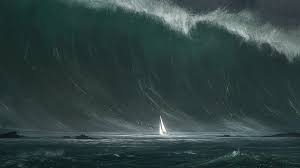
A ship of the imagination with a wave in its future
The literary genre of science fiction was explicitly established in the mid-1920s to provide scientists with the fanciful ideas they publicly disavowed. Amazing Stories, the first magazine devoted to SF, asserted in 1928 that science fiction “takes the basis of science . . . and then adds a thing that is alien to science—imagination. It lights the way. 
Ship of the Science Fiction imagination. They're always running aground.

It was an interesting article.

Monday, December 7, 2015

READINESS AS A STATE OF BEING

Are you Ready Now?

Destroyer Division 8 response to RN in WWI, "We are ready now"
Do you find it interesting that we remember this date every year but we never 'stand to' for it like we do for each anniversary of 9/11? The country is still at war even if the president and Congress no longer are. We have come to expect that the State will do nothing to prevent further attacks except engage in painful and absurdly useless theater.
In war there should be no surprises. No unexpected dawn attacks. No ordinary day.

The link at the top contains an interesting report on the damage and loss of many of the United States Navy's destroyers during World War II. Tough little ships.

The front of the ship is about a mile away, straight down.


Not that long ago, the duty section of any US Navy warship was expected to be able to get the ship underway and proceed out to sea immediately. It might take time to get steam up but the fires could be lit and the ship underway with six hours notice. A diesel or gas turbine ship could get underway in under an hour. I doubt that any duty section today could get the ship underway.

The unspoken corollary was never spoken of. It was never even mentioned. Could any duty section get the ship's main battery into action to repel an armed attack? Would you like to see the effect of small arms and machine gun fire on a ship? Below is the ex USS O'BANNON DD 987 after being hit with Harpoon missiles and 5 inch gunfire. It is now being fired at with the weapons warships use for self defense against terrorists.


Readiness is not just a state of being, it is a state of mind.

UPDATE:

This was released today and shows that forces were available for instant deployment to Benghazi on the anniversary date of 9/11. This is no surprise since we spooled up every year for a number of anniversaries that our adversaries believed should be celebrated by flooding the streets with American blood. This was sent from the Office of the Secretary of Defense to Clinton's Deputy Chief of Staff and 2 other high level drones at State Department then being mismanaged to death by Hillary Clinton. You can see the date and the time below.


The following is wikipedia entry on Jeremy Bash. Some Harvard Law grads don't 'test' as well as others....

Thursday, October 8, 2015

A LOVELY LITTLE STRIKE FROM THE CASPIAN SEA

This is pretty cool. A strike from the Caspian Sea on some junior varsity terrorists but with a unique twist. For once it's not one of our strikes but a Russian strike from the sea. It's been a long time since they did anything like that.


The last time was....

Try to imagine the insanity rampant in a newsroom that publishes garbage like this:
While the Kremlin’s stated aim in the conflict is to fight the Islamic State in Syria, the United States and its allies say Russia is concentrating its firepower against other rebel groups to prevent Assad from being overrun. One video on Wednesday appeared to show the Free Syrian Army, a moderate force backed by the West, firing anti­tank missiles at government troops advancing with Russian air support.
One would think that by this point even a journalist has to accept the fact that there is no such thing as a well armed moderate muslim shooting anti-tank and anti-personnel missiles at government troops even if those troops don't have Soviet airpower in support. They are all complete and total fanatics. I think we can agree that some of them are fighting for their country and their family but they are also supporting one of the most brutal dictatorships of the faithful left on the planet.

There's another point to make with this cruise missile attack.

The Caspian Sea is a Soviet Lake
Even though it is a Soviet lake, look at the warships afloat on this landlocked sea. They are capable of firing land attack missiles at targets up to a thousand miles away in any direction. Contrast with the USN's rather pathetic littoral combat ship which can't project any weapon more than about 8 miles from the ship and even that is straining it beyond it's limits.

On the gripping hand, this looks like the kind of thing that the American military was guilty of all too often. It almost looks like the Russian navy felt that it had to contribute something to the fight against islamic terrorism or be viewed as a waste of resources and so it fought for the right to fire off a full salvo of missiles from the lake in the backyard and hint at what it's ocean going naval units might be capable of.

All in all, a very nice bit of work. I enjoy how the media call this some sort of escalation as if Obama hadn't ordered the navy to fire a hundred land attack missiles into Libya to get Qadaffi.

Thursday, October 23, 2014

OUT OF BATTERY

USS CONSTITUTION will enter a 4 year maintenance phase.

One has to wonder why it will take 3 times longer than it took to build just to 'maintain' her. Oh well, shipyards doing maintenance work on navy ships have been clipping the navy since the navy began.


The pictures I took when I was there are one of the things I regret leaving behind.

Tuesday, September 30, 2014

THE LONG SHIP

I have lost my faith in wikipedia and I say that even though I edit wiki articles. However, as an online repository of startling depth, I still like to delve into it in the wee hours and the hyperlinks can take me hours away from my starting point. I'm afraid my philosophy can be reduced to: read rather than sleep, sleep rather than eat, eat only when you must. I came by it naturally. At 8 all flashlights were confiscated and I wasn't stupid enough to read by candlelight so I hot-wired a D cell battery with a flashlight bulb and carried on reading. If I was hard to wake in the morning, so be it.

This is pretty cool. It is like so many of the wonders of a different age. I, for instance, never thought I'd find the Parthenon in Nashville, Tennessee. What a wonder that is. I really like the remnants of the World Fair and Exposition in San Francisco and Treasure Island. Very little is left in either place.

A replica of the Gokstad ship, named Viking was sailed across the Atlantic to the World's Columbian Exposition in 1893
The ship above was built and sailed to the World's Fair in Chicago to celebrate the 400th anniversary of the arrival of Columbus and his men in the New World. The picture called to mind The Architect's Dream.


Monday, May 12, 2014

Thursday, May 8, 2014

FARLEY MOWAT

Farley Mowat died this week at age 92. We all read and enjoyed his tale of tribulations in The Boat That Wouldn't Float. We were going through our own phase of boating at the time and found his observations about lunatics who boat to be right on the money. His biography claims that he was controversial and that some people didn't care for his books. A lot of people are like that. I, on the other hand, never read any of his non-maritime books. I neither knew nor cared about controversial, I just didn't get around to it.

If you're interested in standout maritime stories about life aboard a salvage ship after the War, you can't do any better than these two books. I reread them for many years.


Sunday, May 4, 2014

ORBITAL HUMOR

Ars Technica has a video up on their page which shows the movement of the Space Shuttle Transport System Transport (STS) Aircraft as it moves from the airfield to the Houston Space Museum. The video is interesting to people like me. I wondered at the puckish humor painted on the 747. Snapshots from the short video below:

The shuttle attachment pintle on top of the 747 where the orbiter goes

The Schematic for people who cannot read

Saturday, May 3, 2014

ICONIC PICTURES OF THE 21ST CENTURY

100 iconic photos of the century so far. They missed a few but all were good.

It's hard to believe it has only been 14 years. It feels longer.


Dwarf Combat Bread in Action

Red Circle Around Earth


Wednesday, April 30, 2014

THE BRIGS

It was due to a confluence of factors from the past that we can now hold ships and their masters responsible for running aground on reefs. The brigs charted the seas for generation after generation and furnished that information to the mapmakers. The ships also did some other good work. I found this article first at Maggie's Farm which took me to American Scientist. When one reads about the myriad cunning artificers of the 17th, 18th and 19th century one doesn't read about the work of the humble men who went down to the sea in ships. It was ships like this that went around the world for centuries and mapped the deeps and, more importantly, the shallows, so that larger ships could follow safely in their wakes and make money and war. They were sailors. Thanks to Anne Bonney for the stear.


From time to time these ships ran aground or were wrecked by storm and needed repairs far beyond the reach of any shipyard or shipwright so they took their own with them. Like Apollo 13 but without radio. In the event, oftentimes, it is enough and more than enough, to simply get home. Many of these ships and their crews did much more but some of them never came home.